Six steps to give a battery a second life instead of letting it go to waste.
Every battery that comes to cirBATT follows the same path: drop-off, collection, testing, reassembly, listing, and payment. Nothing is resold without being measured.
From your garage to a storage pack
A web platform connects battery holders with future buyers of second-life packs — here's what happens in between.
You locate a drop-off point
On cirBATT, you indicate the battery type (e-scooter, e-bike, moped, electric car) and its apparent condition. The platform directs you to the nearest drop-off point.
You drop off the battery at the selected point
Physical drop-off of the battery. A digital receipt logs the origin, model, and declared condition — the starting point of its traceability.
Transport to our Grenoble workshop
Regular collections bring batteries from drop-off points to our workshop, in compliance with lithium battery transport regulations.
Disassembly, sorting, and cell-by-cell testing
Each battery is disassembled. Cells are sorted and tested based on their performance (SOH, series resistance) and safety, then reassembled with our proprietary BMS into new second-life packs.
The pack is published on the platform
Each second-life pack is listed online with its measured characteristics: recovered capacity, cycle count, quality, safety. Buyers can request a quote tailored to their use case.
The buyer gets their pack, you get paid
The buyer receives their second-life battery, cirBATT is paid for the service, and the original owner is paid based on a price tied to the recovered capacity, battery quality, and other criteria.
Why a battery that's “dead” for mobility isn't dead for storage
The cells inside everyday lithium batteries age through two measurable mechanisms. Our entire sorting process is built on these two measurements.
SOH reduction
State of Health drops: the battery stores less energy per kilo (Ah/kg). Below the threshold useful for mobility, the cell remains usable for less demanding applications.
Increase in series resistance (Rs)
Series resistance increases: the battery responds less well to high current demands. This is a critical factor for mobility, much less so for stationary storage.
A BMS designed for second-hand cells
The Battery Management System (BMS) is the electronics that monitors and protects each cell in a pack: it measures voltage and temperature, balances charge between cells, cuts the circuit in case of fault, and communicates the pack's state to the outside world.
Off-the-shelf BMS units are designed for new, homogeneous cells with a known history. Our second-life packs combine cells of different origins and ages: that's why we develop our own BMS, capable of managing heterogeneous cells, detecting performance gaps between them, and securing the pack accordingly.
Our BMS units are also connected: they continuously monitor all vital battery data (voltage, temperature, SOH, cycles) and allow a quick diagnosis directly from a smartphone, or remotely if needed — useful both for technical monitoring and customer support.
This development draws directly on our team's experience in power electronics and protection for the automotive sector, applied here to reuse.
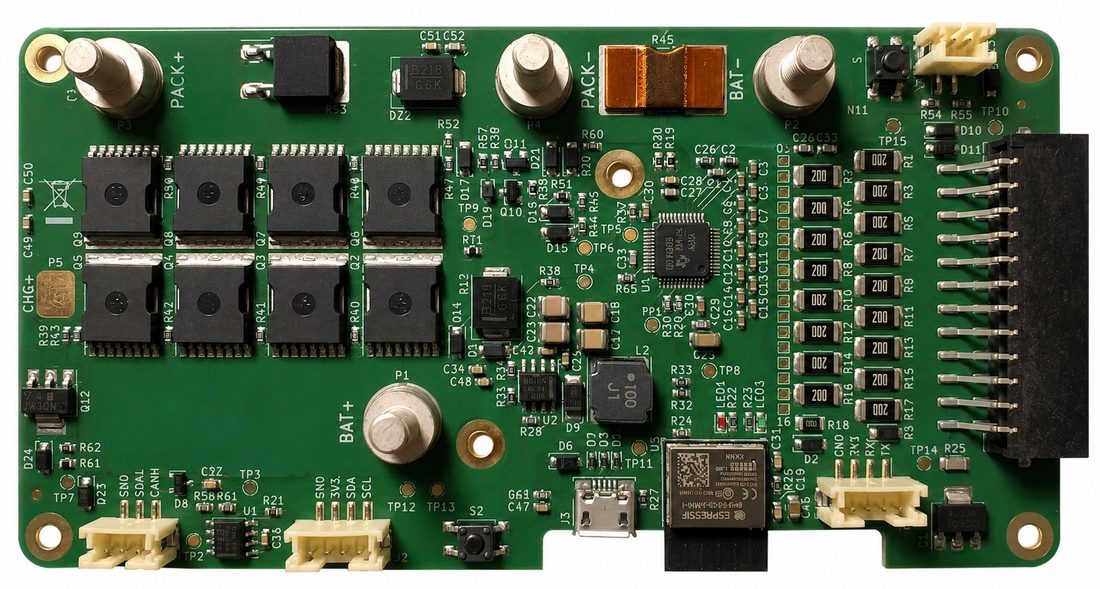 Our BMS board — proprietary prototype
Once requalified, cells find a new use
Packs assembled by cirBATT are suited to many stationary applications.
Peak shaving
Smoothing out consumption peaks to reduce costs tied to subscribed power.
Energy shifting
Storing energy that is produced or cheap to use later.
Microgrids
Autonomous local networks, especially for isolated sites or as a complement to the public grid.
Self-consumption
Storing on-site solar energy to consume it when needed.
UPS
Uninterruptible power supply to protect sensitive equipment during outages.
Closing the loop. Creating value. Every battery collected extends a reuse chain that reduces waste and supports the energy transition.
Drop off a battery or request a quote
Whether you have an end-of-life battery or a stationary storage need, we'll get back to you with an estimate or a tailored proposal within 48 hours.